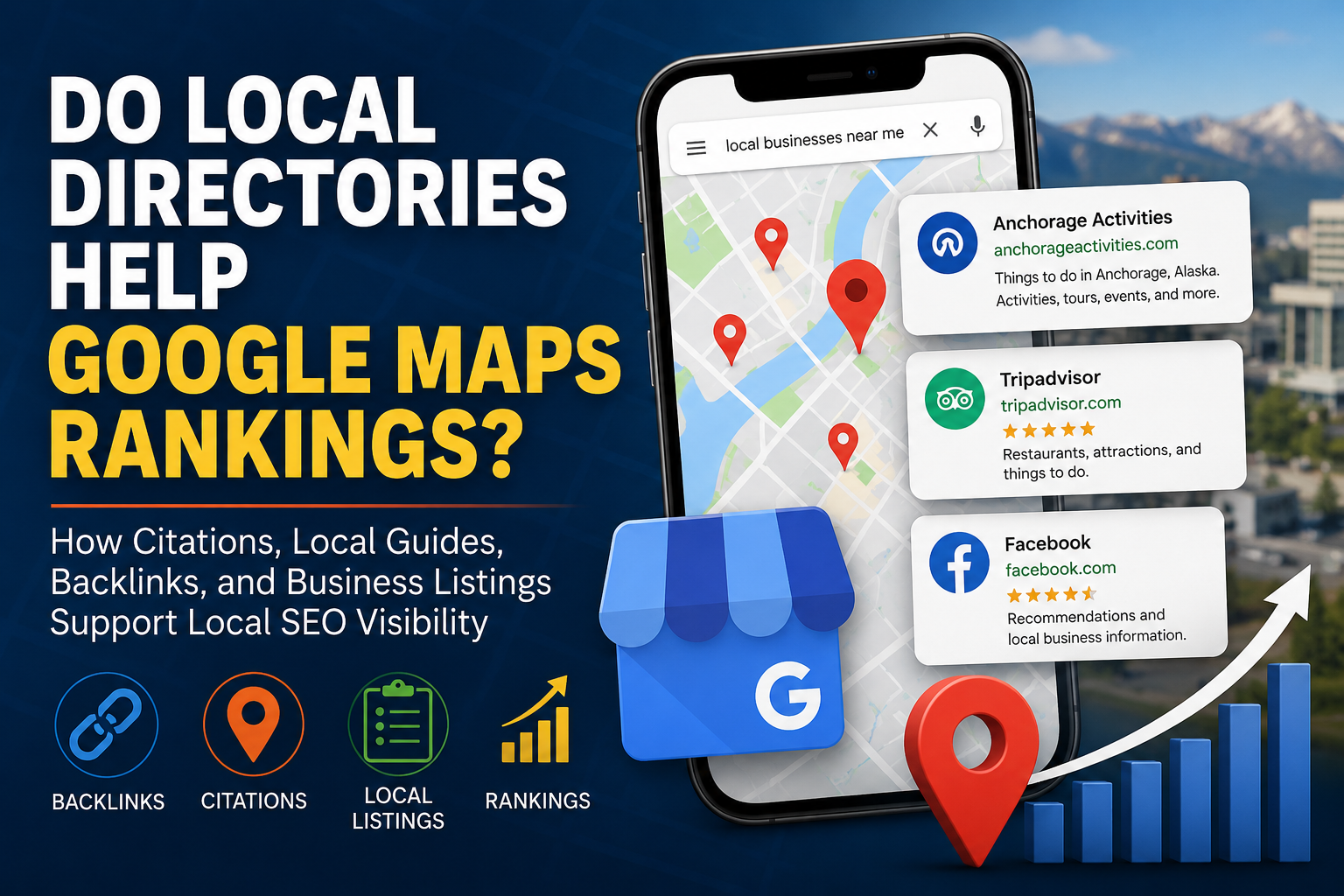
Local directories can help Google Maps visibility, but not because they are magic backlinks. They help when they give Google and customers more proof that your business is real, relevant, local, and worth considering.
The Simple Answer
Yes, local directories can help Google Maps rankings, but they should not be treated as the main strategy.
If your Google Business Profile is incomplete, your reviews are ignored, your hours are wrong, your services are vague, and your photos look abandoned, a few directory links will not fix the real problem.
The best way to think about local directories is simple: they support your local SEO foundation. They do not replace it.
A strong local directory mention can help connect your business to a city, service category, industry, or customer need. That matters because Google Maps visibility is not only about having a website. It is about whether Google can confidently understand what your business does, where it operates, and whether people trust it.
What Google Maps Is Actually Trying to Understand
Google explains local ranking around three major ideas: relevance, distance, and prominence. In normal business language, that means Google is trying to answer three questions.
Local directories mostly fit into the prominence and relevance side of that equation. They can reinforce that your business belongs in a certain place, serves a certain type of customer, or offers a certain type of service.
Your Google Business Profile Still Comes First
Before worrying about directory links, your Google Business Profile needs to be worth ranking.
That means your profile should clearly show what you do, where you work, and why someone should trust you. For most local businesses, that starts with the basics:
- Correct business name, address, service area, hours, website, and contact information.
- The right primary and secondary business categories.
- Specific services instead of vague descriptions.
- Recent photos that show real work, real products, real people, or a real location.
- Consistent review responses that show the business is active.
- Posts, updates, offers, or photos that prove the profile is not abandoned.
If those pieces are weak, start there. You can also run a quick check with our free Google Business Profile tool to see which parts of your profile may be holding back your local visibility.
Where Local Directories Fit Into Google Maps SEO
A local directory is any website that helps people find businesses, places, services, activities, or resources in a specific area. Some are broad directories. Some are industry directories. Some are city guides. Some are tourism or activity sites.
The useful ones have a real audience. They are not just a list of random links built for search engines.
For example, a local guide like AnchorageActivities.com makes sense as a local discovery resource because it is built around helping people find things to do in Anchorage, including activities, events, restaurants, lodging, shopping, museums, tours, and local experiences.
That kind of site is not valuable just because it has a link. It is valuable because it helps real people discover local options. That is the difference.
If you run a business that depends on local discovery, especially a restaurant, attraction, shop, tour company, home service business, event venue, or tourist-facing business, a relevant local guide can support your online presence in a way that feels natural.
Good Directory Links vs. Bad Directory Links
Not every directory listing is worth chasing. Some listings help customers. Some only create clutter.
| Good Local Directory | Bad Local Directory |
|---|---|
| Specific to your city, region, industry, or customer type. | Unrelated to your location, service, or audience. |
| Actually used by people looking for local businesses or activities. | Looks auto-generated and exists only to sell links. |
| Includes accurate business information. | Uses outdated names, wrong phone numbers, or inconsistent addresses. |
| Gives context about what the business does. | Lists the business with no useful description or category relevance. |
| Could send real referral traffic. | Would never realistically be used by a customer. |
The test is simple: would this listing still be worth having if Google did not exist?
If the answer is yes, it is probably a good local SEO opportunity. If the answer is no, it may not be worth much.
The Local SEO Value Is Bigger Than the Backlink
Business owners often think about directories only as backlinks. That is too narrow.
A good local listing can also help with:
- Local relevance: Your business is connected to a real city, region, or neighborhood.
- Category relevance: Your business is grouped with related services, attractions, restaurants, shops, or providers.
- Trust: Customers see your business mentioned somewhere other than your own website.
- Referral traffic: People may click through before they ever search your business name.
- Information consistency: Your name, website, hours, and contact details match across the web.
That last point matters more than people realize. When your business name, website, address, phone number, hours, and service information are inconsistent across the internet, you create confusion for both customers and search engines.
What to Fix Before You Chase Directory Links
Directory links should usually come after your core local SEO work, not before it.
Here is the order I would use for most local businesses:
If your business is not showing up in Maps at all, start with the basics first. We wrote a separate guide on why your business is not showing up on Google Maps that breaks down the common causes.
How to Find Directory Opportunities That Actually Make Sense
Do not start by searching for “free backlink directories.” That usually leads to junk.
Instead, search the way a customer would search.
- Best [service] in [city]
- Things to do in [city]
- Local [industry] directory [city]
- Restaurants near [district or landmark]
- Wedding vendors in [city]
- Home services in [city]
- Local business guide [city]
- Chamber of commerce [city] business directory
Then ask whether the page is useful. Does it help a real customer make a decision? Does it organize local options clearly? Does it rank for searches that matter? Does it feature businesses like yours?
If yes, it may be worth pursuing.
Local Directories Matter Most When Customers Are Still Deciding
A lot of local marketing focuses on people who already know what they want. But many customers are still deciding.
They may not know which company to call. They may not know which restaurant to choose. They may not know which tour to book, which shop to visit, which contractor to trust, or which service provider is nearby.
That is why local discovery matters.
Your business should be visible before someone searches your exact name. That means showing up in Google Maps, appearing on your own website, earning reviews, building useful content, and being mentioned in places where local customers already look.
For some businesses, that could be an activity guide. For others, it could be a neighborhood website, chamber directory, vendor list, industry association, local news article, tourism page, school sponsorship page, or partner website.
The Real Goal Is Local Proof
The goal is not to collect random backlinks.
The goal is to build local proof.
Google, customers, and AI search tools are all trying to understand whether your business is a real, trusted, active option in your market. A strong Google Business Profile helps. A useful website helps. Reviews help. Photos help. Local mentions help.
Local directories are one part of that bigger picture.
Frequently Asked Questions
Do local directories help Google Maps rankings?
They can help, especially when the directory is relevant, trustworthy, and connected to a real city, industry, or customer need. But they are not a replacement for a complete Google Business Profile, strong reviews, accurate information, and active local SEO.
What kind of directory links are best for local SEO?
The best directory links come from sites that real customers might actually use. City guides, industry directories, chamber directories, tourism guides, neighborhood websites, vendor pages, and local partner pages are usually better than generic link directories.
Are citations and backlinks the same thing?
Not exactly. A citation is a mention of your business information, such as your name, address, phone number, website, or hours. A backlink is a clickable link to your website. Some listings include both. Both can support local visibility when the information is accurate and relevant.
Should I pay for directory listings?
Sometimes, but only if the directory has a real audience or clear local value. Paying just to get a link is usually not the right mindset. Ask whether the listing could help customers find you even if Google did not exist.
What should I do before building directory links?
Start by fixing your Google Business Profile, improving your reviews, adding better photos, cleaning up your website, and making sure your business information is consistent. Directory links work better when the rest of your local SEO foundation is already strong.
Want to Know What Is Holding Back Your Google Maps Visibility?
Moose Marketing Group helps local businesses improve their Google Business Profile, strengthen local visibility, and build a cleaner online presence that real customers can actually use.