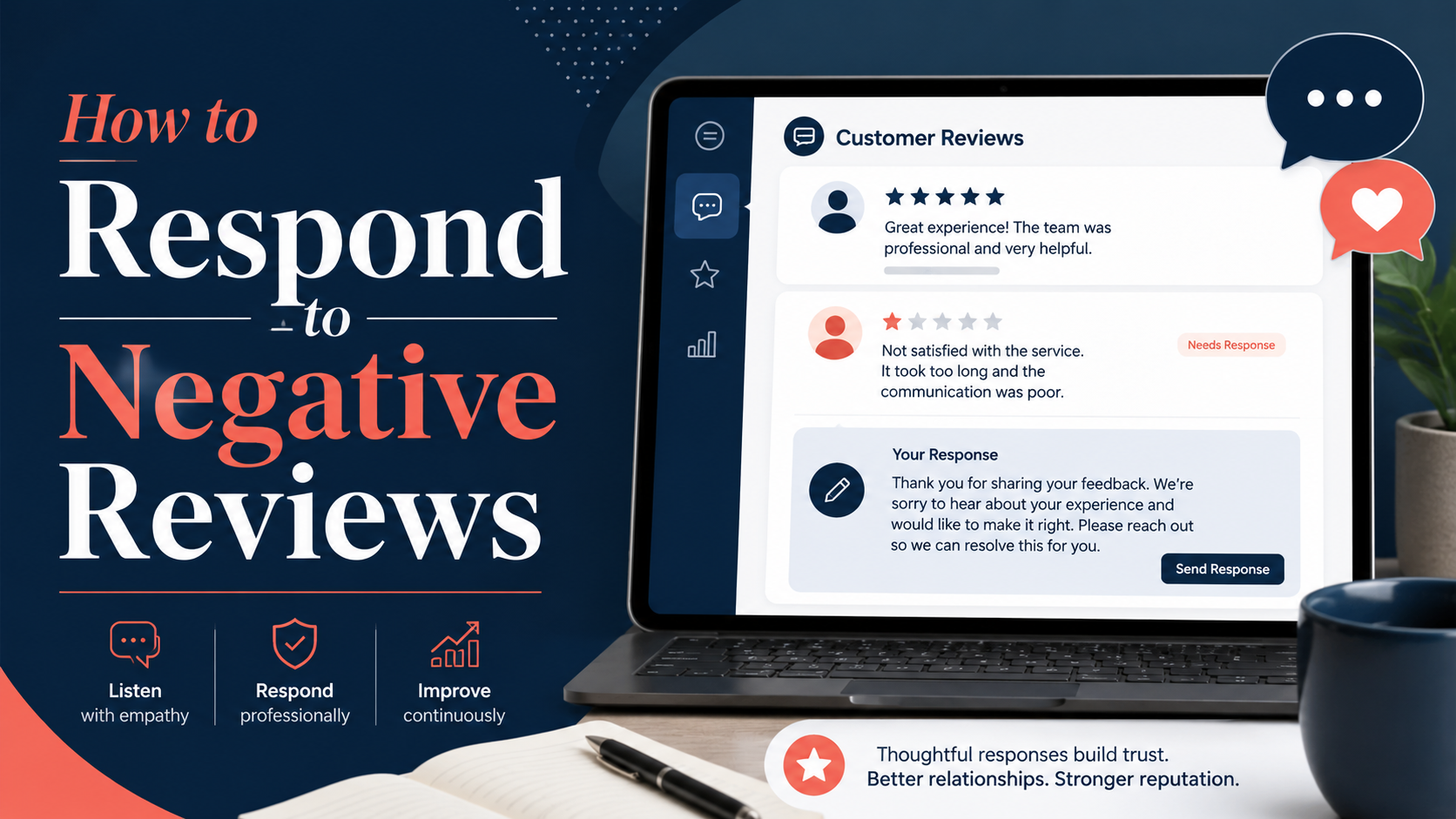
A negative review can feel personal, especially when the reviewer leaves out important details or describes the situation unfairly. Your response, however, is not only for that customer. It is also for every potential customer who reads the exchange while deciding whether to trust your business.
Learning how to respond to negative reviews means knowing how to acknowledge the concern without admitting to something that did not happen, explain the next step without becoming defensive and move sensitive details away from a public page.
Why Responding to Negative Reviews Matters
Customers rarely expect a business to be perfect. They do expect the business to take concerns seriously. A thoughtful response can show readers that someone is paying attention and that problems will not simply be ignored.
Google recommends keeping review replies professional, helpful, direct and conversational. Google also notes that helpful replies demonstrate that a business values customer feedback and may help the business stand out to potential customers. You can read Google’s full guidance on responding to customer reviews.
A strong response can accomplish four things:
- Show prospective customers that your business is responsive.
- Give the reviewer a clear path toward resolving the problem.
- Correct a misunderstanding without starting a public argument.
- Demonstrate the standard your business follows when something goes wrong.
How to Respond to Negative Reviews in Five Steps
You do not need a lengthy explanation or a carefully scripted corporate statement. Most effective replies can be built from five simple parts.
Pause and verify what happened
Do not reply while you are angry. Check appointment records, invoices, messages and notes from the employees involved. Your response should be based on what you can verify, not your first emotional reaction.
Acknowledge the concern
Begin by recognizing the customer’s experience. You can acknowledge their frustration without agreeing with every accusation or accepting responsibility for something that did not occur.
Address the specific issue
Refer briefly to the main concern, such as a delayed appointment, communication problem or unexpected charge. Avoid a generic response that could have been copied beneath any review.
Offer a clear next step
Tell the reviewer what you would like them to do next. Provide an appropriate phone number, email address or contact page and identify the person or department that can help.
Move the details offline
Do not discuss account information, payment details, employee records or other private information publicly. Invite the customer to continue the conversation directly so the issue can be investigated properly.
A simple negative review response template
Hi [Name], I’m sorry to hear that [brief description of concern]. That is not the experience we want customers to have. We would like to review what happened and see what can be done to help. Please contact [person or department] at [phone or email] so we can discuss the details directly.
Do not copy this word for word beneath every review. Use it as a structure, then add enough detail to show that you actually read what the customer wrote.
Negative Review Response Examples
The right reply depends on the complaint. These examples show how to respond without becoming argumentative, overexplaining the situation or sounding like an automated customer service message.
Example 1: The customer experienced a real service problem
Review: “Our appointment was scheduled for 9:00, but nobody arrived until after 11:00. I had to miss most of the morning at work.”
Response: “Hi Jordan, I’m sorry that we arrived so far outside the scheduled window and did not communicate the delay clearly. I understand how disruptive that would be when you arranged your workday around the appointment. Please contact our office at [phone number] and ask for [name] so we can review the visit and make this right.”
Example 2: The reviewer misunderstood the service or price
Review: “They charged me more than the price advertised on their website.”
Response: “Hi Taylor, thank you for bringing this up. The price shown online covers [base service], while the final invoice may change when additional work is approved. We understand that this should be explained clearly before the work begins. Please contact [name] at [phone number] so we can review your estimate and invoice with you.”
Example 3: You cannot locate the customer in your records
Review: “Terrible company. They took my money and never finished the job.”
Response: “Hi Chris, we take this allegation seriously, but we have not been able to identify a project matching the details in this review. Please contact us through our website or call [phone number] with the name and address associated with the project. We would like to determine whether this involves our business and investigate what happened.”
Example 4: The review is vague
Review: “Worst service ever. Do not use this business.”
Response: “Hi Morgan, we are sorry to hear that you were disappointed. We would like to understand what happened, but the review does not include enough information for us to identify the visit. Please contact [name or department] at [phone number or email] with the date and service location so we can look into it.”
Example 5: The business made a mistake and has already corrected it
Review: “My order was wrong, and I had to drive all the way back.”
Response: “Hi Avery, you were right to expect the correct order the first time, and we are sorry that you had to make a second trip. We appreciate you giving our team the opportunity to replace it. We have also reviewed the mistake with the staff involved so we can reduce the chance of it happening again.”
What Not to Say in a Negative Review Response
Do this
- Stay calm and professional.
- Refer to the specific concern.
- Explain the next step clearly.
- Protect the customer’s privacy.
- Write for future customers.
Avoid this
- Insulting or mocking the reviewer.
- Writing a long public defense.
- Sharing private account details.
- Threatening legal action impulsively.
- Posting the same reply repeatedly.
Do not argue point by point
A detailed rebuttal may feel satisfying, but it usually makes the disagreement more visible. Correct one or two important facts if necessary, then offer to continue the conversation privately.
Do not use a fake apology
Phrases such as “We’re sorry you feel that way” often sound dismissive. A better response acknowledges the frustration itself: “We understand why the delay was frustrating.”
Do not promise a result before investigating
Avoid promising a refund, replacement or disciplinary action until you understand the situation. Promise the next step instead: “We will review the service record and contact you.”
Do not turn the response into an advertisement
A reviewer who had a bad experience does not need a sales pitch. Focus on the concern and the resolution. Google specifically recommends keeping review responses conversational rather than promotional.
Should You Apologize When the Customer Is Wrong?
You can express concern without admitting fault. An apology can recognize the customer’s frustration rather than agreeing with an inaccurate version of events.
| Instead of saying | Consider saying |
|---|---|
| “We are sorry we overcharged you.” | “We are sorry the final price was unexpected, and we would like to review the invoice with you.” |
| “You are lying about what happened.” | “The account details we have do not match the description in the review, so we would like to investigate further.” |
| “Our employee would never do that.” | “This does not match the standard we expect from our team, and we would like to understand what occurred.” |
| “You agreed to the charge.” | “Our records indicate that the additional work was approved, but we would be glad to review the documentation with you.” |
When Should You Report a Negative Review?
Google does not remove a review simply because it is negative, unfair or based on a disagreement. A review generally needs to violate a Google content policy before it is eligible for removal.
A review may be worth reporting when it appears to contain:
- Spam or content unrelated to an actual experience.
- A conflict of interest, such as a review from a competitor.
- Harassment, threats or targeted personal attacks.
- Private or confidential information.
- Impersonation or deliberately deceptive content.
- Review extortion or a demand for payment in exchange for removal.
Review Google’s prohibited and restricted content policies before submitting a report. You can then follow Google’s instructions for reporting an inappropriate review.
Businesses should also be cautious about attempts to suppress honest criticism. The Consumer Review Fairness Act protects consumers’ ability to share honest opinions about a business and restricts the use of standardized contract terms that punish customers for leaving negative reviews.
What to Do After You Respond
A public reply is only the beginning. The goal is to determine what happened, resolve what can be resolved and identify whether the complaint points to a larger business problem.
- Contact the customer privately. Use the contact method provided in your response when possible.
- Document the complaint. Record the issue, relevant employees, dates and final outcome.
- Fix the underlying process. Look for communication gaps, scheduling problems or unclear pricing.
- Follow up after resolving the issue. Confirm that the customer received the promised correction.
- Do not pressure the customer to change the review. Focus on resolving the experience. The customer can decide whether to update the review.
Responding well is only one part of managing your reputation. Your business also needs a consistent way to request feedback from real customers. Our guide to getting more customer reviews explains how to ask at the right time without making the request feel forced.
Create a Consistent Review Response Process
Review responses become much easier when the business has a process instead of treating each complaint as an emergency.
Assign one person to monitor reviews
Decide who is responsible for checking your Google Business Profile and other review platforms. This may be an owner, office manager or marketing partner. The responsibility should not be vague.
Create guidelines, not rigid scripts
Give the person responding a framework for tone, privacy and escalation. Templates can save time, but every response should reflect the actual review.
Set escalation rules
Determine which reviews require an owner, manager or attorney to review the response before it is published. Threats, discrimination allegations, injuries and serious financial disputes should not be handled casually.
Track recurring complaints
One negative review may reflect a difficult interaction. Five reviews mentioning unanswered calls or missed appointments probably indicate a process problem. Customer feedback becomes more useful when patterns are recorded and acted upon.
You can use Moose Marketing Group’s free Google Business Profile Quick Check to evaluate whether your profile appears active, complete and trustworthy. For a broader assessment of your online visibility, use our free local marketing guide.
Frequently Asked Questions
Should businesses respond to every negative review?
In most cases, yes. A response shows that the concern was noticed and gives the reviewer a way to contact the business. An exception may be obvious spam or abusive content that should be reported instead. Even then, a brief public response may be appropriate while the report is reviewed.
How quickly should I respond to a negative review?
Respond after you have gathered enough information to write accurately, but do not leave the review unanswered for an extended period. For many businesses, responding within one business day is a practical target. A careful response is more important than an immediate emotional one.
Can a business delete a negative Google review?
A business cannot directly delete a customer’s Google review. It can report the review if the content appears to violate Google’s policies. Google decides whether the review qualifies for removal.
Should I offer a refund in my public response?
Do not promise a refund publicly unless the decision has already been made and no private details are involved. Invite the customer to contact you so the account, purchase or service record can be reviewed first.
Can responding to reviews help local SEO?
Google states that replying to reviews shows that you value customer feedback and that helpful replies can help your business stand out. Review responses should still be written for customers rather than stuffed with keywords. Local visibility also depends on relevance, distance, prominence and the overall quality of your Google Business Profile.
Should I include my city or service keywords in a response?
Include a service or location only when it fits naturally. For example, mentioning “your plumbing appointment in Edmond” may clarify the situation. Repeating phrases such as “best plumber in Oklahoma City” would sound promotional and reduce the credibility of the response.
Your Response Becomes Part of Your Reputation
A negative review does not get the final word. Your response gives prospective customers additional context and shows how your business behaves when someone is dissatisfied.
The best responses are not designed to prove that the customer is wrong. They show that your business is calm, attentive and willing to investigate. That impression may matter more to a future customer than the original complaint.
Reviews are also only one part of how customers evaluate a local business. An accurate, active and well-maintained profile can make the business easier to understand and trust. Read our analysis of what helps a business rank higher on Google Maps for a broader look at local visibility.