If you have ever searched for a local business on Google Maps, you have probably wondered why some companies appear near the top while others get buried below their competitors.
At Moose Marketing Group , I help local businesses improve their visibility through Google Business Profile management and local SEO. I wanted to better understand which visible Google Business Profile factors appeared to have the strongest relationship with Google Maps rankings.
Instead of relying on general assumptions, I opened Google Maps, searched across our local metropolitan area, collected information from several business profiles, and compared that information with each business’s position in the search results.
What I found challenged one of the most common assumptions about local SEO: the business with the most Google reviews does not always rank the highest.
Why I Wanted to Test Google Maps Ranking Factors
A lot of local business owners assume that ranking higher on Google Maps is mostly about having more reviews than everyone else.
That assumption makes sense at first. When you see a business with hundreds or thousands of reviews, it feels reasonable to assume that Google would automatically place that business above companies with fewer reviews.
Google Maps rankings are more complicated than that. Google explains that local search results are primarily based on relevance, distance, and prominence. You can read Google’s own guidance in its article about improving your local ranking on Google .
Reviews are part of that picture, but they are not the only visible factor on a Google Business Profile. I wanted to compare review count with other profile characteristics, including average rating, review responses, recent photos, and profile completeness.
How I Conducted the Google Maps Analysis
I started by opening Google Maps and expanding the visible search area to cover the entire local metro. I wanted the search to represent a broad service area rather than one neighborhood or a single point in the city.
I then searched for the term “plumber.” I did not manually change the sorting order or apply additional filters.
I also made sure Google Maps was not simply using my current physical location as the center of the search. This reduced the chance that proximity to my device would be the main reason one company appeared above another.
Although I used plumbing businesses for the sample, the purpose of the analysis was broader. I wanted to better understand Google Maps ranking factors that may be relevant to many types of local businesses, including contractors, home service companies, restaurants, medical practices, retail stores, and professional service providers.
Google Maps results can change depending on the searcher’s location, device, search history, competition, and other signals. The rankings in this analysis represent the results displayed during this specific search rather than a permanent ranking order.
The Google Business Profile Factors I Measured
After the search results appeared, I reviewed each business and recorded five visible characteristics from its Google Business Profile.
- Average star rating: The business’s average Google review rating.
- Total review count: The total number of Google reviews displayed on the profile.
- Review response rate: The percentage of the business’s 10 most recent reviews that received a response.
- Recent photo activity: The number of photos added during the previous 30 days.
- Profile completeness: Whether the profile included important information such as a website, business hours, business description, service areas, and business photos.
I also recorded each company’s position in the Google Maps results. A ranking of 1 represented the highest position in the sample.
Business owners who are unsure whether their profile is complete can use the free Moose Marketing Group Google Business Profile Health Checker to identify common areas that may need attention.
How I Analyzed the Google Business Profile Data
I entered the collected information into Microsoft Excel and compared each Google Business Profile factor with the company’s Google Maps ranking position.
Because a lower ranking number represents a better position, I looked for factors where stronger values appeared alongside rankings closer to position 1.
The purpose of the analysis was to identify relationships between visible profile characteristics and ranking position. It was not designed to prove that any single factor directly caused a business to move higher in Google Maps.
What the Google Maps Ranking Analysis Revealed
Average Star Rating Had a Strong Relationship With Ranking Position
Average Google review rating was one of the clearest patterns I noticed.
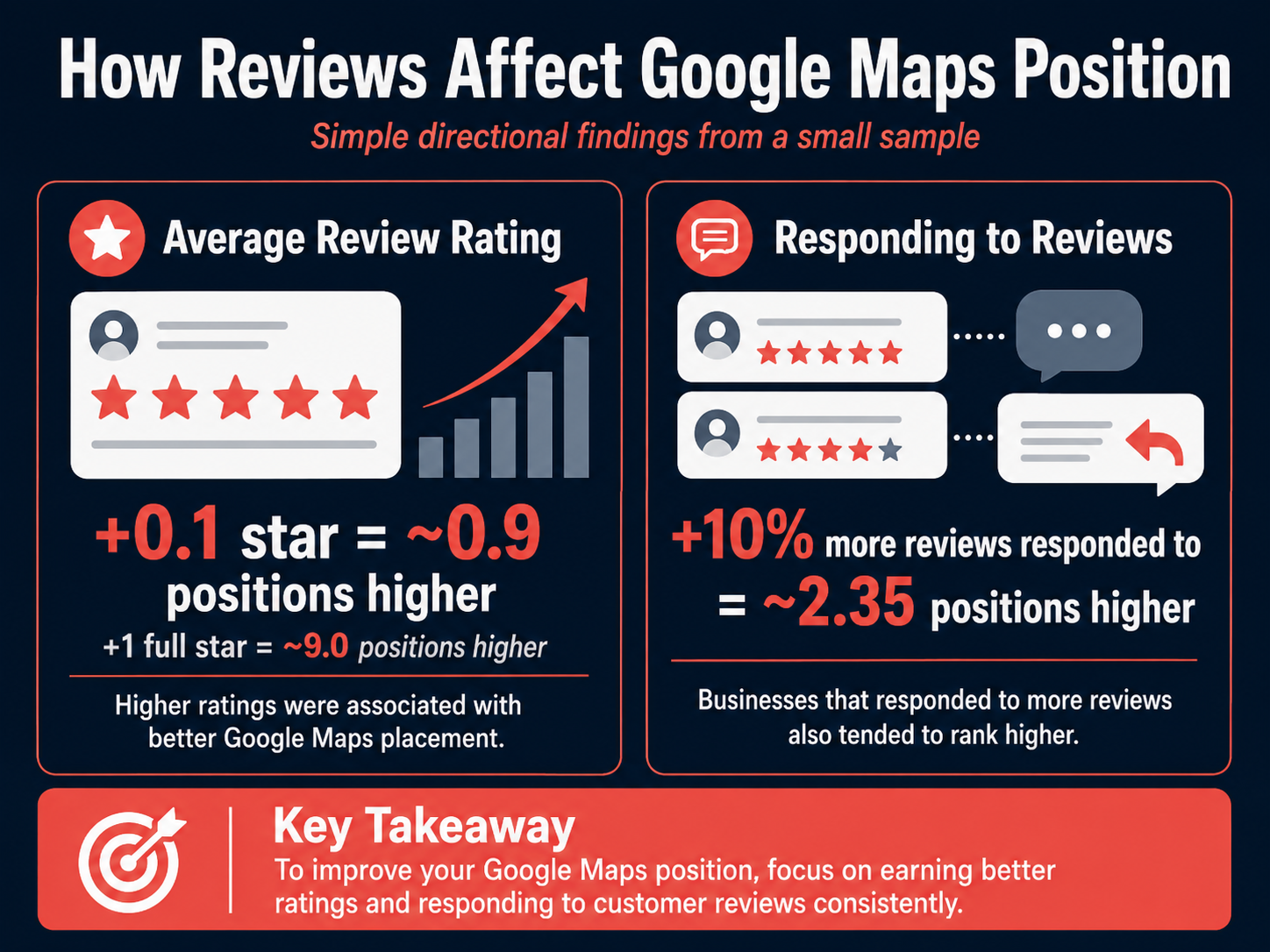
Businesses with stronger average ratings generally appeared closer to the top of the Google Maps results. In this sample, the relationship between star rating and position appeared stronger than the relationship between total review count and position.
This does not mean that every business with a 4.9-star rating will outrank every business with a 4.7-star rating. Google considers many different signals when ordering local results.
It does suggest that local businesses should not ignore review quality while focusing entirely on review volume. A company may have hundreds of reviews, but a declining average rating can still affect how potential customers view the business.
Responding to Google Reviews Was Associated With Better Rankings
Review response rate also showed a strong relationship with Google Maps position.
Businesses that responded to a larger percentage of their recent reviews generally appeared higher than businesses that rarely responded or did not respond at all.
Responding to reviews can also help a business beyond possible ranking benefits. It shows potential customers that the company is active, attentive, and willing to communicate.
A response gives the business an opportunity to thank satisfied customers, address complaints, clarify misunderstandings, and demonstrate how the company handles feedback.
Google also encourages businesses to communicate with customers through review responses. Its guide to reading and replying to Google reviews explains how businesses can manage review responses directly through their profiles.
This analysis does not prove that responding to a review will immediately increase a company’s ranking. It does suggest that businesses appearing higher in the results were more likely to manage their recent reviews actively.
Total Review Count Was Less Important Than Expected
The most surprising finding was that total review count was not the strongest ranking-related factor in the sample.
Some businesses with hundreds or thousands of reviews appeared below businesses with fewer total reviews.
This does not mean review volume is unimportant. A larger number of legitimate reviews can improve customer trust, strengthen credibility, and give potential customers more information about a business.
The important distinction is that review count alone did not fully explain ranking position. A business with fewer reviews, a stronger average rating, and more consistent review responses could still compete with a business that had collected far more reviews.
What These Findings Mean for Local Businesses
If you own or manage a local business, the main takeaway is simple: do not treat Google reviews as a numbers game only.
A complete Google Business Profile strategy should include:
- Providing a customer experience that supports stronger average ratings.
- Asking satisfied customers for honest Google reviews.
- Responding to both positive and negative reviews.
- Checking new reviews regularly instead of allowing them to go unanswered.
- Keeping business information accurate and complete.
- Adding recent photos and updates to keep the profile active.
The businesses that appeared strongest in this analysis were not simply collecting reviews. They were actively managing their Google Business Profiles and maintaining a stronger overall presence.
How to Improve Your Google Maps Ranking
Based on this analysis, I would recommend focusing on the fundamentals before chasing complicated local SEO tactics.
Complete Your Google Business Profile
Make sure your business name, phone number, website, hours, service areas, categories, description, and other profile details are accurate.
Google provides instructions for businesses that need to add or claim a Google Business Profile .
Create a Consistent Review Process
Ask real customers for honest feedback after completing a service or transaction. Avoid waiting until reviews appear on their own.
The goal should not be to collect reviews at any cost. The goal should be to make it easy for satisfied customers to share their genuine experiences.
Respond to Reviews Regularly
Review responses should be part of your normal business routine. Thank customers for positive reviews and respond professionally when someone leaves a complaint.
A thoughtful response can help future customers understand that your business takes service and communication seriously.
Keep Your Profile Active
Add recent photos, publish updates when appropriate, and make sure the profile reflects the services your business currently provides.
None of these actions guarantees the number one position on Google Maps. Together, however, they can create a stronger and more trustworthy profile for both Google and potential customers.
Frequently Asked Questions About Google Maps Rankings
Does responding to reviews improve Google Maps rankings?
In this analysis, businesses that responded to more of their recent reviews tended to appear higher in the Google Maps results.
That does not prove that review responses directly caused the ranking difference. It does suggest that active review management was associated with stronger visibility in this sample.
Are more Google reviews always better?
More legitimate reviews are usually helpful, but a higher review count does not automatically result in a higher Google Maps ranking.
In this analysis, average star rating and review response rate had stronger relationships with ranking position than total review count.
What is the most important Google Maps ranking factor?
Google says local rankings are primarily based on relevance, distance, and prominence.
Among the visible profile factors measured in this analysis, average review rating and review response rate showed the strongest relationships with ranking position.
Can a small business outrank a competitor with more reviews?
Yes. A business with fewer reviews may still compete if it has a stronger average rating, more consistent review responses, complete business information, and an actively managed profile.
How often should a business respond to Google reviews?
Ideally, a business should respond consistently to both positive and negative reviews. Responses do not need to be long, but they should be personal, professional, and relevant to the customer’s feedback.
Check the Health of Your Google Business Profile
If you are not sure whether your Google Business Profile is helping or hurting your local visibility, start with the free Google Business Profile Health Checker .
You can also learn more about local marketing and Google Business Profile management by visiting Moose Marketing Group .
Final Thoughts
This local business analysis showed that Google Maps rankings are not only about which company has collected the most reviews.
In this sample, average star rating and review response rate had stronger relationships with Google Maps position than total review count.
Local businesses should continue earning genuine reviews, but they should not stop there. Protecting the average rating, responding consistently to customer feedback, keeping profile information accurate, and maintaining an active Google Business Profile may be just as important as collecting more reviews.
If your business depends on local customers, your Google Business Profile is one of the most important parts of your online presence. Keeping it complete, active, and trustworthy can make a meaningful difference in how customers find and evaluate your business.